
Handkerchief
Unknown Artist
late 19th century
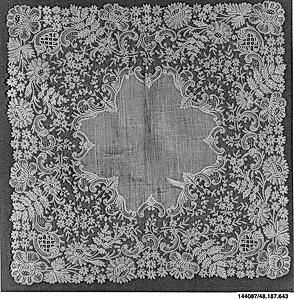
Medium
Bobbin lace, Brabant Valenciennes, linen
Dimensions
13 1/2 inches square (34.3 cm)
Classification
Textiles-Laces
Culture
Belgian
Department
European Sculpture and Decorative Arts
Museum
Metropolitan Museum of Art, New York, NY
Credit
Bequest of Catherine D. Wentworth, 1948
Accession Number
48.187.643
Rights
Public Domain
Tags
Art Historical Context
This delicate handkerchief, crafted in the late 19th century by an unknown Belgian artisan, exemplifies the pinnacle of bobbin lace artistry from the Brabant region. Measuring 13½ inches square, it is made of fine linen threads in the prestigious Brabant Valenciennes style—a type of lace renowned for its geometric picots (small loops) and intricate, light-as-air patterns. Floral motifs, suggested by its tagging, bloom across the square, showcasing the lacemaker's skill in creating naturalistic designs that appear weightless and ethereal. Bobbin lace, a technique using small wooden bobbins to twist and interlace threads over a patterned pillow, reached new heights of refinement in 19th-century Belgium, particularly in Flanders. Valenciennes lace from Brabant was prized worldwide for its durability and purity, often used in fashion and as cherished gifts. Handkerchiefs like this were status symbols among the elite, blending utility with opulent decoration. Now housed in the Metropolitan Museum of Art's European Sculpture and Decorative Arts Department through the 1948 bequest of Catherine D. Wentworth, this piece invites visitors to appreciate the labor-intensive heritage of Belgian textile craftsmanship—a fading art that once defined luxury in Victorian Europe.