
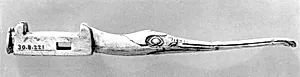
Handle for a Model Bird Trap
Unknown Artist
ca. 1550–1295 B.C.
Medium
Ivory
Dimensions
L. 14.5 cm (5 11/16 in); W. 3 cm (1 3/16 in)
Classification
Model, bird trap handle
Period
New Kingdom
Department
Egyptian Art
Museum
Metropolitan Museum of Art, New York, NY
Credit
Theodore M. Davis Collection, Bequest of Theodore M. Davis, 1915
Accession Number
30.8.221
Rights
Public Domain
Tags
Art Historical Context
This delicate ivory handle, crafted around 1550–1295 B.C. during Egypt's New Kingdom (Dyn 18), once belonged to a model bird trap—a miniature replica of everyday hunting tools placed in tombs to ensure the deceased's sustenance in the afterlife. Measuring just 14.5 cm long, it exemplifies the Egyptians' meticulous attention to provisioning the next world, where models of farms, workshops, and hunts symbolically provided eternal abundance. Bird trapping was a vital activity along the Nile, supplying food and feathers for rituals, making such models both practical in concept and spiritually essential. Carved from elephant ivory, a luxurious import symbolizing wealth and elite status, the handle showcases the era's virtuoso craftsmanship. Artisans likely used fine tools to shape its ergonomic form, possibly adorned with subtle incised details evoking feathers or traps, though wear from millennia has softened its edges. Dynasty 18, a pinnacle of Egyptian power under pharaohs like Hatshepsut and Tutankhamun, produced such tomb furnishings in opulent materials, blending utility with profound religious belief. Today, this artifact from the Theodore M. Davis Collection at the Metropolitan Museum of Art offers a window into ancient ingenuity, reminding us how the Egyptians blurred art, daily life, and eternity in astonishingly lifelike miniatures.