
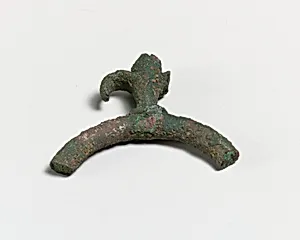
Handle of a bowl
Unknown Artist
7th–6th century BCE
Medium
Bronze
Dimensions
Other: 1 11/16 in. (4.3 cm)
Classification
Bronzes
Culture
Cypriot
Department
Greek and Roman Art
Museum
Metropolitan Museum of Art, New York, NY
Credit
The Cesnola Collection, Purchased by subscription, 1874–76
Accession Number
74.51.5449
Rights
Public Domain
Art Historical Context
This delicate bronze handle from a bowl, crafted by an unknown Cypriot artist in the 7th–6th century BCE, offers a glimpse into the vibrantworking traditions of ancient Cyprus. Measuring just 1 11/16 inches (4.3 cm), it the precision of Bronze Age techniques, likely cast or hammered to fit seamlessly onto a ceramic or metal vessel. Housed in the Metropolitan Museum of Art's Greek Roman Art Department as part of the renowned Cesnola Collection—acquired through public subscription in 1874–76—this artifact highlights Cyprus's role as a cultural crossroads in the eastern Mediterranean. During this Archaic period, Cypriot artisans blended influences from Greece, the Near East, and Egypt, producing functional yet artistically refined objects like this handle. Bronze, a prestigious alloy of copper and tin, was valued for its durability and luster, often used in household wares, rituals, or elite dining. The handle's modest scale underscores the everyday artistry of Cypriot society, where even utilitarian items showcased skilled craftsmanship and symbolic motifs, though specifics of its decoration remain understated in surviving examples. As a survivor from over 2,500 years ago, this piece invites us to ponder the hands that once gripped it—perhaps during communal feasts or sacred offerings—reminding visitors of Cyprus's enduring legacy in ancient metallurgy and cross-cultural exchange.