
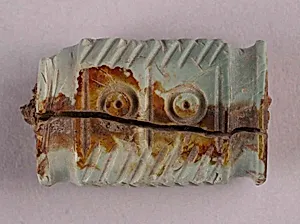
Handle or Ornament or Tool
Unknown Artist
8th–13th century
Medium
Stone; carved and pierced
Dimensions
H. 1 in. (2.6 cm) W. 11/16 in. (1.7 cm) D. 3/8 in. (1 cm)
Classification
Stone
Department
Islamic Art
Museum
Metropolitan Museum of Art, New York, NY
Credit
Rogers Fund, 1948
Accession Number
48.101.239
Rights
Public Domain
Art Historical Context
This delicate stone object, titled *Handle or Ornament or Tool*, hails from the Islamic world between the 8th and 13th centuries—a golden era of artistic innovation under dynasties like the Abbasids Fatimids. Craft from stone through meticulous carving and piercing techniques, measures just 1 inch (2.6 cm) high, making it a marvel of miniature artistry. Such precision reflects the Islamic tradition of transforming everyday materials into objects of beauty and utility, where even small implements could embody spiritual and aesthetic refinement. The pierced design suggests intricate openwork, a hallmark of Islamic craftsmanship seen in architecture, ivories, and jewelry, allowing light to play through filigree patterns while ensuring structural integrity. Its ambiguous function—as a handle for a vessel, personal ornament, or specialized tool—highlights the versatility of medieval Islamic artifacts, often blending form and function seamlessly. These pieces were prized for their technical virtuosity, evoking the era's advancements in stoneworking. Acquired through the Rogers Fund in 1948 and housed in the Metropolitan Museum of Art's Islamic Art Department, this artifact invites us to ponder the anonymous artisan's skill. In a vast tradition without signatures, it stands as a testament to enduring cultural ingenuity, bridging the practical and the poetic.