
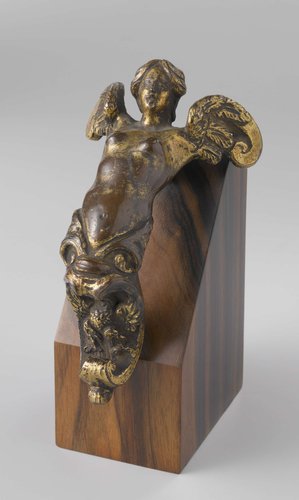
Handvat
Unknown Artist
1500 - 1600
Medium
bronze (metal)
Dimensions
8; 16; 11
Rights
Public Domain
About this artwork
Purchased with the support of the Vereniging Rembrandt
Art Historical Context
Nestled in the rich tradition of Renaissance metalwork, the *Handvat* (Dutch for "handle") is finely crafted bronze artifact from 1500–1600, likely originating from the Low Countries. a compact 16 cm high, 8 cm wide, and 11 cm thick, this small yet masterful object exemplifies the era's blend of functionality and artistry. Bronze, a durable alloy prized for its malleability and lustrous finish, was cast using sophisticated lost-wax techniques, allowing artisans to achieve intricate details on everyday items like door pulls, furniture fittings, or liturgical implements. Though the creator remains unknown, the *Handvat* reflects the Northern Renaissance's emphasis on realism and utility, where even utilitarian objects became miniature sculptures. Its acquisition, supported by the Vereniging Rembrandt—a Dutch foundation dedicated to preserving national heritage—underscores its cultural significance. Visitors, imagine gripping this 500-year-old relic: a tangible link to the workshops of Antwerp or Amsterdam, where craftsmanship elevated the mundane to the monumental.