
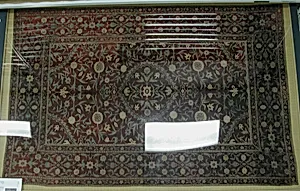
Hanging with a Medallion Carpet Design
Unknown Artist
1628–58
Medium
Silk; cut velvet
Dimensions
Textile: L. 84 in. (213.4 cm) W. 61 in. (154.9 cm) Mount: H. 100 3/4 in. (255.9 cm) W. 70 in. (177.8 cm) D. 2 5/8 in. (6.7 cm)
Classification
Textiles-Woven
Department
Islamic Art
Museum
Metropolitan Museum of Art, New York, NY
Credit
Bequest of George Blumenthal, 1941
Accession Number
41.190.256
Rights
Public Domain
Art Historical Context
Step into the opulent world 17th-century Islamic with this magnificent *Hanging with a Medallion Carpet Design*, crafted 1628 and 1658. Woven from luxurious silk using the cut velvet technique, this hanging measures an impressive 84 by 61 inches (213.4 by 154.9 cm) and emulates the intricate patterns of high-end knotted-pile carpets. Produced in the Islamic world—likely an Ottoman weaving center—the central medallion motif, surrounded by floral and arabesque elements, reflects the era's fascination with Persian carpet aesthetics, adapted for flat-woven grandeur. The cut velvet method is a marvel of textile artistry: silk threads are woven into loops on a ground fabric, then meticulously sheared to create a soft, plush pile that catches light and adds depth to the bold motifs. This labor-intensive process made such pieces rare treasures, reserved for palaces, mosques, or elite homes to adorn walls and evoke the prestige of floor coverings too valuable to tread upon. A bequest to the Metropolitan Museum of Art from George Blumenthal in 1941, this hanging showcases the cultural splendor of Islamic design, blending technical virtuosity with symbolic richness. Its survival highlights the enduring allure of these textiles in global art history.