
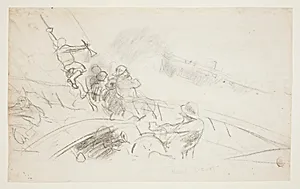
Hard-a-Port
Classification
seascapes
Department
Smithsonian Collection
Museum
Smithsonian American Art Museum
Credit
Gift of Charles Savage Homer, Jr.
Accession Number
1912-12-42
Rights
Public Domain
About this artwork
Research in Progress
Art Historical Context
Winslow Homer, one of America's foremost realist painters (1836–1910), captured the raw power of the sea in *Hard-a-Port*, created around 1900. By this time, Homer had retreated to his coastal studio in Prouts Neck, Maine, where he devoted himself to seascapes that celebrated the drama of maritime life. The title refers to a nautical command directing the helm sharply to port (left), evoking tense moments of navigation amid turbulent waters—a theme Homer explored with unflinching realism after his early career as a Civil War illustrator. Homer's seascapes, like this one from the Smithsonian American Art Museum's collection (gift of Charles Savage Homer, Jr.), showcase his mastery of light, atmosphere, and human struggle against nature. Though the medium is unknown, his works often blended oil and watercolor to convey crashing waves and stormy skies with vivid immediacy, influencing generations of American artists. Classified as a seascape, *Hard-a-Port* reflects the era's fascination with seafaring adventure and the perils of the Atlantic, underscoring Homer's shift from Civil War heroism to the sublime forces of the natural world. This piece invites visitors to ponder the resilience of sailors, much like Homer's own solitary life by the sea. Research continues to uncover more about its creation, adding to its allure in the Smithsonian collection.