
Harlequin
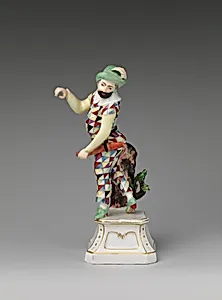
Medium
Hard-paste porcelain decorated in polychrome enamels, gold
Dimensions
Overall (confirmed): 8 1/4 x 4 3/8 x 3 9/16 in. (21 x 11.1 x 9 cm)
Classification
Ceramics-Porcelain
Culture
German, Höchst
Department
European Sculpture and Decorative Arts
Museum
Metropolitan Museum of Art, New York, NY
Credit
The Jack and Belle Linsky Collection, 1982
Accession Number
1982.60.222
Rights
Public Domain
Tags
Art Historical Context
Step into the whimsical world of 18th-century German porcelain with *Harlequin*, a delightful hard-paste porcelain figurine by the Höchst Manactory around 1750–53. Modeled by Johann Christoph Ludwig Lücke, this 8¼-inch tall figure captures the mischievous spirit of Harlequin, the iconic trickster from commedia dell'arte theater. Dressed in his signature diamond-patterned costume, adorned with a black mask and pointed hat, he embodies the playful energy of Rococo decorative arts, blending humor and elegance for the elite homes of Europe. Höchst, near Frankfurt, was a key player in Germany's "porcelain fever," rivaling Meissen as one of the first to master true hard-paste porcelain—a durable, translucent material Europeans perfected to challenge Chinese imports. Founded in 1746 under Prince Clemens of Hesse, the manufactory specialized in colorful figural sculptures like this one, fired at high temperatures and then meticulously painted in vibrant polychrome enamels and accented with gold for a luxurious sheen. This piece, from The Jack and Belle Linsky Collection at The Metropolitan Museum of Art, highlights porcelain's rise as both art and status symbol. Its intricate modeling and vivid decoration showcase the technical virtuosity of Höchst artisans, offering visitors a tangible glimpse into Enlightenment-era leisure and fantasy.