
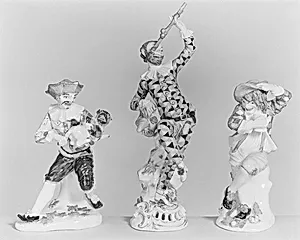
Harlequin dancing
Medium
Hard-paste porcelain
Dimensions
Height: 10 1/4 in. (26 cm)
Classification
Ceramics-Porcelain
Culture
German, Meissen
Department
European Sculpture and Decorative Arts
Museum
Metropolitan Museum of Art, New York, NY
Credit
Gift of Irwin Untermyer, 1964
Accession Number
64.101.82
Rights
Public Domain
Tags
Art Historical Context
**Harlequin Dancing** (1763–64), a delightful hard-paste porcelain figurine modeled by Johann Joachim Känd for the Meissen Manuf, captures the exuberant spirit of 18th-century European porcelain. Standing at 101/4 inches tall, this lively depiction of the mischievous commedia dell'arte character Harlequin mid-dance showcases Kändler's mastery in creating dynamic, theatrical figures. Meissen, the pioneering German factory founded in 1710, hard-paste porcelain—a durable, translucent material rivaling Chinese imports—allowing for intricate modeling and vibrant polychrome enameling that brought sculptures to life. Kändler, Meissen's chief sculptor from 1733 until his death in 1775, elevated porcelain figurines to high art through his rococo style: elegant curves, playful poses, and exaggerated expressions. Harlequin, the acrobatic trickster from Italian improvised comedy popular across Europe, embodies the era's fascination with performance and fantasy. This piece, gifted to the Metropolitan Museum of Art in 1964, reflects the opulence of Saxon courts, where such tableaus adorned lavish dinners, blending craftsmanship with cultural whimsy. Today, it highlights Meissen's enduring legacy in decorative arts, inviting visitors to appreciate the technical virtuosity— from delicate lacework details to fluid motion frozen in fired clay—that made porcelain a symbol of luxury and innovation.