
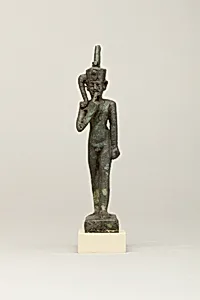
Harpokrates in red crown
Unknown Artist
664–30 B.C.
Medium
Cupreous metal
Dimensions
H. 13.2 cm (5 3/16 in.); W. 3.1 cm (1 1/4 in.); D. 4.7 cm (1 7/8 in.)
Classification
Statuette, Harpokrates, red crown
Period
Late Period–Ptolemaic Period
Department
Egyptian Art
Museum
Metropolitan Museum of Art, New York, NY
Credit
Gift of Darius Ogden Mills, 1904
Accession Number
04.2.615
Rights
Public Domain
Art Historical Context
Behold the exquisite "Harpokrates in crown," a diminutive yet captivating figurine from ancient Egypt's Late Period to Ptolemaic era (664–30 B.C.). Crafted cupreous metal—likely a bronze alloy—this 13.2 cm tall statue depicts Harpokrates, the youthful Greek form of the god Horus, adorned with the iconic red crown (Deshret) symbol Lower Egypt's power and fertility. Its slender form (just 3.1 cm wide and 4.7 cm deep) suggests it was a personal votive object, perhaps carried as an amulet for protection and divine favor. In Egyptian mythology, Harpokrates embodies silence, secrecy, and the emerging sun, often shown with a finger to his lips—a gesture later influencing Greco-Roman iconography. Produced during a time of cultural fusion under Persian and Ptolemaic rule, this piece reflects enduring religious traditions amid political upheaval, highlighting the god's role as a protector of the pharaoh and households. Housed in the Metropolitan Museum of Art's Egyptian Art department since its 1904 gift from Darius Ogden Mills, the figurine's fine casting showcases Late Period metalworking prowess, with its smooth surfaces and symbolic headdress evoking the Nile's eternal mysteries. A testament to ancient devotion, it invites us to ponder the intimate spirituality of everyday ancient lives.