
Harpoon Head
Unknown Artist
4th century
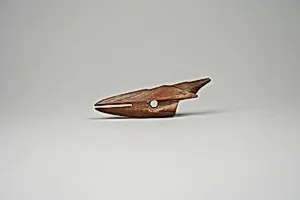
Medium
Ivory (walrus)
Dimensions
H x W: 3 1/8 x 5/8in. (7.9 x 1.6cm)
Classification
Bone/Ivory-Implements
Culture
Old Bering Sea
Department
Arts of Africa, Oceania, and the Americas
Museum
Metropolitan Museum of Art, New York, NY
Credit
Purchase, The Houghton Foundation, Inc. Gift, 1977
Accession Number
1977.165.2
Rights
Public Domain
Tags
Art Historical Context
This exquisite harpoon head, carved from walrus ivory in the 4th century hails from the Old Bering Sea culture of the Arctic Bering Strait region. Measuring just 3 1/8 x 5/8 inches, this compact implement was a vital tool for ancient hunters pursuing sea mammals like seals and whales in the harsh, ice-bound waters. Crafted by an unknown artist, it the ingenuity of early Arctic peoples, who transformed durable walrus tusk into functional yet finely worked objects essential for survival. The Old Bering Sea culture, flourishing around 200 BCE to 400 CE, is renowned for its sophisticated bone and ivory carvings, blending utility with artistry. This harpoon head likely served as a toggle-head, detaching to secure prey upon impact—a clever design innovation for reliable hunting in unpredictable seas. Its classification as a bone/ivory implement highlights the cultural reliance on marine resources, where walrus ivory's toughness and workability made it ideal for tools that doubled as status symbols. Today, this piece resides in the Metropolitan Museum of Art's Department of Arts of Africa, Oceania, and the Americas, acquired through a 1977 gift. It offers a window into a seafaring world where every carve told a story of endurance and mastery over nature.