
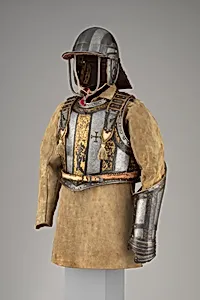
Harquebusier's Armor of Pedro II, King of Portugal (reigned 1683–1706) with Buff Coat
ca. 1683 and later; buff coat, 17th–18th century
Medium
Steel, gold, leather, textile
Dimensions
armor (15.113.1–.5): Wt. 43 lb. 5 oz. (19.6 kg); helmet: 14 x 11 x 15 1/4 in. (35.6 x 27.9 x 38.7 cm); Wt. 9 lb. 10 oz. (4354 g); breastplate: 18 1/2 x 16 5/16 x 7 13/16 in. (47 x 41.4 x 19.8 cm); Wt. 10 lb. 14 oz. (4944 g); backplate: 17 1/2 x 16 1/4 x 8 1/2 in. (44.5 x 41.3 x 21.6 cm); Wt. 11 lb. 5 oz. (5126 g); reinforcing breastplate: 17 3/8 x 16 3/16 x 6 13/16 in. (44.1 x 41.1 x 17.3 cm); Wt. 9 lb. 6 oz. (4264 g); bridle gauntlet: 5 1/2 x 19 7/16 x 6 3/4 in. (14 x 49.4 x 17.1 cm); Wt. 2 lb. 2 oz. (953 g); buff coat (29.158.885): L. 35 in. (88.9 cm)
Classification
Armor for Man
Culture
British, London; buff coat, European
Department
Arms and Armor
Museum
Metropolitan Museum of Art, New York, NY
Credit
Armor: Rogers Fund, 1915; buff coat: Bashford Dean Memorial Collection, Funds from various donors, 1929
Accession Number
15.113.1–.5; 29.158.885
Rights
Public Domain
Art Historical Context
Behold the resplendent Harquebusier's Armor of II, King of Portugal crafted around 1683 in London by master armorers Daniel Tachaux and Holden. This magnificent ensemble, now paired with a 17th–18th-century European buff coat—a sturdy leather jacket worn beneath plate for added protection—was made for the newly crowned monarch (r. 1683–1706). Weighing a formidable 43 pounds overall, it exemplifies the late Baroque fusion of and opulence, with plates richly gilded in gold royal display. As firearms rendered full plate armor largely obsolete by the late 17th century, this suit represents a ceremonial of the armorer's art. Designed for a harquebusier—a cavalryman wielding an early musket—its components include a close helmet, breastplate, backplate, reinforcing plate, and bridle gauntlet, each meticulously measured and balanced for both parade and limited combat. The intricate gilding and precise forging highlight British London's renown for exporting high-end arms to European courts, underscoring international prestige and craftsmanship. Housed in The Metropolitan Museum of Art's Arms and Armor Department, this treasure invites us to ponder the twilight of chivalric tradition amid the dawn of modern warfare—a king's bold statement of power and heritage.