
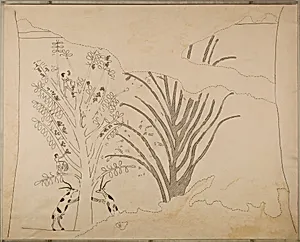
Harvesting Sicamore Figs, Tomb of Djari
ca. 2050–2000 B.C.
Medium
Ink on Paper
Dimensions
H. 52 cm (20 1/2 in); w. 66 cm (26 in) - as mounted, scale 1:3, framed: h. 54.3 cm (21 3/8 in); w. 67.6 cm (26 5/8 in)
Classification
Facsimile, Djari (TT 366), sicamore fig trees, goats
Period
First Intermediate Period–Middle Kingdom
Department
Egyptian Art
Museum
Metropolitan Museum of Art, New York, NY
Credit
Rogers Fund, 1931
Accession Number
INST.1979.2.5
Rights
Public Domain
Tags
Art Historical Context
This ink-on-paper facsimile captures a vibrant scene from the Tomb of Djari, an official buried near Thebes during Egypt’s Dynasty 11 (ca. 2050–2000 B.C.). Created by an unknown copyist at one-third the size of the original wall painting, the drawing records the harvesting of syc figs, a fruit prized for both nourishment and ritual offerings. Amid the trees, deer appear among the branches, illustrating the lively natural world the ancient Egyptians wished to preserve for eternity. Such agricultural vignettes were standard in Middle Kingdom tombs, where images of abundant harvests magically sustained the deceased in the afterlife. The sycamore tree itself held sacred associations with goddesses such as Hathor, linking daily labor to divine protection. By reproducing the composition in fine ink lines, the copyist preserved details of gesture, costume, and landscape that might otherwise have faded on the limestone walls. Acquired by the Metropolitan Museum in 1931, this scaled reproduction allows visitors to study the artistic conventions of the First Intermediate Period–Middle Kingdom transition—balanced figures, rhythmic repetition, and a harmonious blend of human activity and nature—without traveling to the original tomb.