
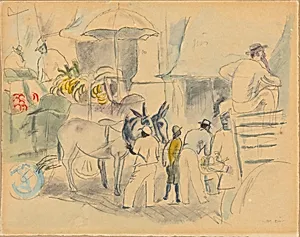
Havana
c. 1915-1920
Medium
watercolor and graphite on paper mounted to paperboard
Dimensions
sheet: 18.1 x 23.1 cm (7 1/8 x 9 1/8 in.) mount: 23 x 31 cm (9 1/16 x 12 3/16 in.)
Classification
Drawing
Department
CG-W
Museum
National Gallery of Art, Washington, D.C.
Credit
The John U. and Evelyn S. Nef Collection
Accession Number
2011.60.2
Rights
Public Domain
Art Historical Context
Jules Pascin’s *Havana* captures a fleeting moment from the artist’s travels in the Americas during the late 1910s. Created between 1915 and 1920, this intimate watercolor and graphite drawing on paper reflects Pascin’s signature approach to works on paper, where fluid washes and delicate graphite lines combine to evoke atmosphere rather than precise detail. The small scale—roughly the size of a postcard—invites close viewing, drawing the eye into a composition that suggests a Cuban street or harbor scene. Pascin, a Bulgarian-born artist who became a central figure in the School of Paris, often used watercolor to record places he encountered during his wanderings. Here the medium’s transparency and speed allow him to convey light, movement, and a sense of transience typical of his travel sketches. The work’s presentation on a larger mount further emphasizes its character as a portable, personal record rather than a formal studio piece. Acquired as part of the John U. and Evelyn S. Nef Collection, *Havana* now resides in the National Gallery of Art, where it offers visitors a glimpse of Pascin’s restless curiosity and his ability to distill the spirit of a place with economical means.