
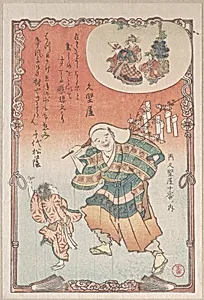
Hawker of Love Letters
19th century
Medium
Part of an album of woodblock prints (surimono); ink and color on paper
Dimensions
8 1/8 x 5 7/16 in. (20.6 x 13.8 cm)
Classification
Prints
Culture & Period
Japan · Edo period (1615–1868)
Department
Asian Art
Museum
Metropolitan Museum of Art, New York, NY
Credit
H. O. Havemeyer Collection, Bequest of Mrs. H. O. Havemeyer, 1929
Accession Number
JP2241
Rights
Public Domain
Tags
Art Historical Context
Step into the vibrant world of Edo-period Japan with *Hawker of Love Letters*, delicate woodblock print by Kubo Shunman from the 19th century This intimate scene, part of a surimono album, a street vendor peddling love letters amid figures of men and women,oking the playful romance and everyday poetry of urban life in Tokyo (then Edo). At just 8 1/8 x 5 7/16 inches, its small scale invites close viewing, revealing Shunman's mastery in blending narrative charm with subtle social observation. Surimono, meaning "printed things," were luxurious, privately commissioned woodblock prints often produced for New Year's greetings or poetry gatherings (kyōka circles). Printed with ink and color on paper, they exemplify ukiyo-e artistry— the "pictures of the floating world"—prized for their refined techniques like precise carving and vibrant pigmentation. Shunman, a versatile artist active in the late Edo era (1615–1868), elevated this genre with his poetic flair, making works like this a window into Japan's cultured leisure. From the H. O. Havemeyer Collection at The Metropolitan Museum of Art, this print highlights the global appeal of Japanese prints, once collected by Western enthusiasts for their exquisite craftsmanship and cultural depth. A delightful glimpse of fleeting affections!
About the Artist
Kubo Shunman · 1757–1820
Japanese, 1757–1820