
Haystacks
ca. 1930
Medium
Painting
Classification
Painting
Department
Smithsonian Collection
Museum
Smithsonian American Art Museum
Credit
Smithsonian American Art Museum, Gift of Irwin M. Sparr
Accession Number
1983.95.214
Rights
Public Domain
Tags
About this artwork
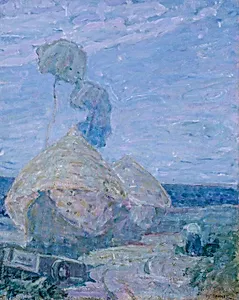
The thick, unblended strokes of blues and purples in this image characterize Henry Ossawa Tanner’s later work. He made his reputation from his religious paintings while living in Paris from 1891 until his death in 1937. But like the French painters he admired, Tanner made a point of painting out in the countryside as well.
Art Historical Context
Henry Ossawa Tanner's *Haystacks* (ca. 1930) captures the serene beauty of the rural countryside, a departure from the religious subjects that defined his illustrious career. After moving to Paris in 189 to escape racial barriers in America, Tanner became the first African American to achieve international acclaim with luminous biblical scenes. Yet, like the French Impressionists he admired—such as Monet—he embraced plein air painting, venturing outdoors to directly observe and depict nature's fleeting light and atmosphere. In this late work, Tanner employs thick, unblended strokes of blues and purples, evoking twilight or early dawn over haystacks, a cart, and farm elements. This impasto technique adds texture and vitality, reflecting Post-Impressionist influences while showcasing his evolving style in his final years before his death in 1937. Housed in the Smithsonian American Art Museum through the gift of Irwin M. Sparr, the painting highlights Tanner's versatility and his deep connection to the French landscape tradition. *Haystacks* invites visitors to appreciate how Tanner bridged American identity with European modernism, turning everyday rural motifs into profound meditations on light and land.