
"He Turned Their Waters into Blood"
c. 1865/1880
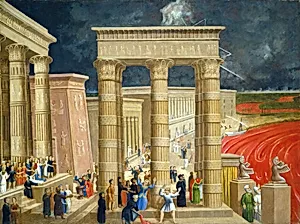
Medium
oil on canvas
Dimensions
overall: 76.8 x 102.9 cm (30 1/4 x 40 1/2 in.) framed: 95.2 x 121.9 x 6.3 cm (37 1/2 x 48 x 2 1/2 in.)
Classification
Painting
Department
CAB
Museum
National Gallery of Art, Washington, D.C.
Credit
Gift of Edgar William and Bernice Chrysler Garbisch
Accession Number
1964.23.3
Rights
Public Domain
Art Historical Context
Erastus Salisbury Field created "He Turned Their Waters into Blood" in oil on canvas around 1865–1880, during the later phase of his career as a self-taught American folk artist. The work depicts the first of the biblical plagues of Egypt, in which the Nile River turns to blood at Moses’s command, drawing directly from the Book of Exodus. Field’s straightforward, narrative approach and bold use of color on this sizable canvas—measuring roughly 30 by 40 inches—made such religious scenes accessible and impactful for 19th-century viewers. Painted in the years following the Civil War, the subject likely carried added resonance, evoking ideas of divine judgment and deliverance during a time of national upheaval. Field, who began as a portrait painter in rural Massachusetts, increasingly turned to large-scale biblical themes that combined moral instruction with visual storytelling. The medium of oil allowed him to achieve rich, dramatic contrasts that heighten the miraculous event. Today the painting resides in the collection of the National Gallery of Art, a gift from Edgar William and Bernice Chrysler Garbisch, ensuring that Field’s vivid interpretation of this Old Testament moment continues to engage museum visitors with its blend of faith and folk artistry.
About the Artist
Erastus Salisbury Field · 1805–1900
1805–1900