
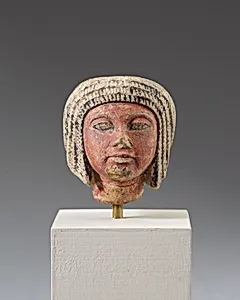
Head from a statuette
Unknown Artist
ca. 1353–1336 B.C.
Medium
Limestone, paint
Dimensions
H. 3.5 cm (1 3/8 in.); W. 3.1 cm (1 1/4 in.); D. 3.2 cm (1 1/4 in.)
Classification
Head, statuette
Period
New Kingdom, Amarna Period
Department
Egyptian Art
Museum
Metropolitan Museum of Art, New York, NY
Credit
Gift of Mrs. John Hubbard and Egypt Exploration Society, 1931
Accession Number
31.114.1
Rights
Public Domain
Tags
Art Historical Context
This delicate limestone head, once part of a small statuette, hails from Egypt's New Kingdom during the Amarna Period (ca. 1353–1336 B.C.), a revolutionary era under Pharaoh Akhenaten's Eighteenth Dynasty. This time marked a dramatic shift in Egyptian art, abandoning rigid, idealized forms for more naturalistic and exaggerated features—think elongated skulls, slender necks, and expressive faces that reflected the royal court's devotion to the sun god Aten. Measuring just 3.5 cm high, this fragment captures the intimacy of personal or votive sculptures, likely intended for private devotion or burial. Carved from fine limestone and traces of original paint remain, highlighting the Amarna artists' mastery of combining sculpture with vibrant polychromy. Paint added life-like flesh tones, jewelry, and cosmetic details, making divine or royal figures vividly approachable. Though the full statuette is lost, such heads embody the period's cultural upheaval: Akhenaten's monotheistic reforms challenged centuries of tradition, influencing art's bold expressiveness before a swift return to conservatism. Today, at the Metropolitan Museum of Art (gift of Mrs. John Hubbard and the Egypt Exploration Society, 1931), it invites us to ponder a fleeting artistic golden age, where pharaohs dared to humanize the divine.