
Head Lime Container
Unknown Artist
6th–9th century
Medium
Shell, metal alloy, stone, wood, fiber
Dimensions
H. 1 3/4 × W. 1 1/8 × D. 7/8 in. (4.4 × 2.9 × 2.2 cm)
Classification
Shell-Containers
Culture
Wari
Department
Arts of Africa, Oceania, and the Americas
Museum
Metropolitan Museum of Art, New York, NY
Credit
The Michael C. Rockefeller Memorial Collection, Bequest of Nelson A. Rockefeller, 1979
Accession Number
1979.206.620
Rights
Public Domain
Tags
Art Historical Context
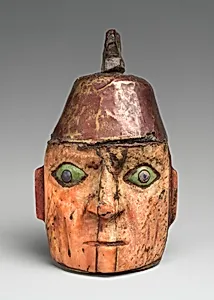
This exquisite *Head Lime Container* from Wari culture of ancient Peru, dating to the 6th–9th century, offers a glimpse into the daily rituals of a powerful Andean empire. The Wari, centered in the Ayacucho region, were masterful builders and artisans whose influence spread across much of Peru before the rise of the Inca. Crafted as a small, portable vessel—measuring just 1 3/4 inches tall—this object was likely used to hold lime powder, essential for chewing coca leaves, a widespread practice that enhanced endurance, suppressed hunger, and held spiritual significance in Andean societies. Carved primarily from shell with accents of metal alloy, stone, wood, and fiber, the container takes the form of a stylized human head, showcasing the Wari's skill in multi-material assemblage and fine detailing. The realistic features—perhaps evoking an ancestor or deity—highlight their expertise in miniature sculpture, a technique that allowed for intricate personalization despite the object's diminutive size. Housed in The Metropolitan Museum of Art's Arts of Africa, Oceania, and the Americas department as part of The Michael C. Rockefeller Memorial Collection, this artifact underscores the Wari's cultural sophistication. Such lime containers were intimate possessions, bridging the mundane and the sacred, and reveal how everyday objects embodied profound social and ritual meaning in pre-Columbian Peru.