
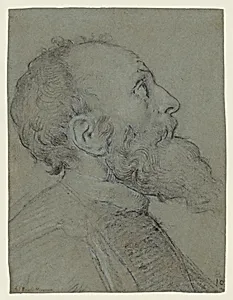
Head of a Bearded Man
Paolo Veronese (Paolo Caliari)|School of Paolo Veronese, ca. 1565
About this artwork
In the vibrant world of 16th-century Venetian art, Paolo Veronese (8–1588), a master of the late Renaissance and early Mannerist styles, created dynamic compositions filled with grandeur and luminous color. This drawing, *Head of a Bearded* (ca. 1565), attributed to Veronese or his workshop, exemplifies his preparatory sketches. Rendered in black chalk heightened with white on greenish-blue paper, it measures a modest 10 5/16 x 7 7/8 inches, yet captures profound character in profile. Veronese's technique here showcases his skill in chiaroscuro—using dark chalk for shadows and white highlights to model the man's rugged features, beard, and turban-like headwear. Such studies were essential for his large-scale paintings and frescoes, like those in the Doge's Palace, allowing him to refine expressions and poses. The prepared paper enhances depth, a hallmark of Venetian draftsmanship that bridged observation and imagination. Now in the Robert Lehman Collection at The Metropolitan Museum of Art, this intimate work reveals the thoughtful process behind Veronese's epic narratives. It invites visitors to appreciate how a simple head study fueled the drama of Renaissance Venice, blending realism with artistic invention.