
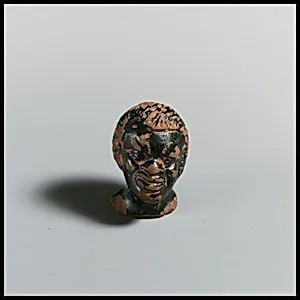
Head of a Black African man
Unknown Artist
4th century BCE
Medium
Terracotta
Dimensions
H. 3 cm.
Classification
Terracottas
Culture & Period
Greek, South Italian, Campanian · Late Classical
Department
Greek and Roman Art
Museum
Metropolitan Museum of Art, New York, NY
Credit
Gift of J. Pierpont Morgan, 1917
Accession Number
17.194.2142
Rights
Public Domain
Tags
Art Historical Context
This small terracotta head, created in the 4th century BCE in Campania, South Italy, offers a rare glimpse into the diverse world of Late Classical Greek art. Standing just three centimeters tall, the piece likely formed part of a larger figurine or served as a votive object. Its careful modeling captures distinctive facial features, reflecting the technical skill of Campanian artisans who worked in this accessible medium. During this period, Greek colonies in southern Italy flourished as vibrant centers of trade and cultural exchange across the Mediterranean. The representation of a Black African man highlights the region’s connections with North Africa and beyond, reminding us that ancient Greek societies encountered and depicted people from varied backgrounds. Such works were often placed in sanctuaries or homes, serving both devotional and decorative purposes. Acquired by the Metropolitan Museum through the generosity of J. Pierpont Morgan in 1917, this modest yet expressive head invites visitors to consider how even the smallest objects can illuminate broader historical narratives of mobility, identity, and artistic expression in the ancient world.