
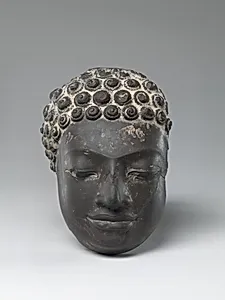
Head of a Buddha
Unknown Artist
8th century
Medium
Stone
Dimensions
H. 7 11/16 in. (19.5 cm); W. 5 1/4 in. (13.3 cm); D. 2 1/2 in. (6.4 cm)
Classification
Sculpture
Culture & Period
Thailand · Mon-Dvaravati period
Department
Asian Art
Museum
Metropolitan Museum of Art, New York, NY
Credit
Purchase, Anonymous Gift, 1983
Accession Number
1983.13
Rights
Public Domain
Tags
Art Historical Context
This serene stone head of a Buddha, carved in 8th-century Thailand during the Mon-Dvarati period, exemplifies the flowering of an early Southeast Asian kingdom centered in the Chao Phraya River basin. The Dvaravati culture (roughly 6th–11th centuries) marked a pivotal era for Theravada Buddhism's spread from India through Mon communities, blending Indian influences with local aesthetics. Sculptures like this were often created for temple shrines, serving as focal points for meditation and devotion. Crafted from stone, the modestly scaled head (7 11/16 inches high) showcases the period's hallmark rounded facial features, almond-shaped eyes, and tranquil expression, evoking enlightenment and compassion. Artisans employed precise carving techniques to achieve smooth surfaces and subtle modeling, highlighting the durability of stone for enduring religious icons amid tropical climates. This piece reflects Dvaravati's role as a cultural bridge, influencing later Thai and Khmer art traditions. Acquired by the Metropolitan Museum of Art in 1983 through an anonymous gift, it invites visitors to ponder the universal appeal of Buddhist imagery—timeless symbols of peace amid ancient innovation.