
Head of a Buddha
Unknown Artist
late 5th–early 6th century
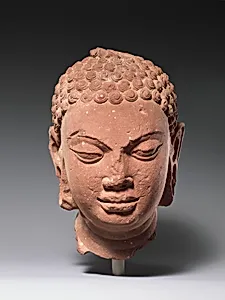
Medium
Red sandstone
Dimensions
H. 10 in. (25.4 cm); W. 5 5/8 in. (14.3 cm); D. 6 1/2 in. (16.5 cm) On base: H. 14 3/4 in. (37.5 cm)
Classification
Sculpture
Culture & Period
India (Uttar Pradesh, Mathura) · late Gupta period
Department
Asian Art
Museum
Metropolitan Museum of Art, New York, NY
Credit
Gift of Doris Rubin, in memory of Harry Rubin, 1989
Accession Number
1989.236.1
Rights
Public Domain
Tags
Art Historical Context
This serene *Head of a Buddha*, from red sandstone in late 5th– 6th century India hails from Mathura in Uttar Pradesh—a renowned center of Gupta-period sculpture. Standing 14¾ inches tall on its base, the piece exemplifies the region's mastery of stone carving, where artisans quarried vibrant red sandstone to create luminous, lifelike figures. Mathura's workshops produced some of ancient India's most iconic Buddhist art, blending spiritual symbolism with classical realism. The late Gupta period, often called India's "Golden Age," marked a pinnacle of artistic refinement under imperial patronage. This Buddha head captures the era's idealized aesthetic: smooth, rounded facial features, a gentle smile (known as the *ursashravas*), and elongated earlobes symbolizing wisdom and renunciation. The subtle modeling of the ushnisha (cranial protuberance) and meditative gaze reflect profound Buddhist ideals of enlightenment, making it a powerful emblem of devotion. Displayed in the Metropolitan Museum of Art's Asian Art department, this gift from Doris Rubin honors the Gupta sculptors' enduring legacy. Visitors are drawn to its tranquil presence, evoking the devotional fervor of ancient Mathura temples. (198 words)