
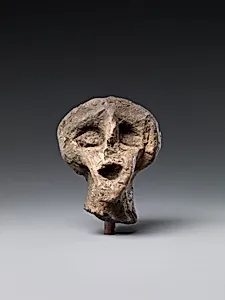
土偶|Head of a Clay Figure (Dogū)
Unknown Artist
Medium
Earthenware
Dimensions
H. 2 1/8 in. (5.4 cm); W. 1 5/8 in. (4.1 cm); D. 1 1/2 in. (3.8 cm)
Classification
Ceramics
Culture & Period
Japan · Late Jomon period (ca. 1500–1000 B.C.)
Department
Asian Art
Museum
Metropolitan Museum of Art, New York, NY
Credit
The Harry G. C. Packard Collection of Asian Art, Gift of Harry G. C. Packard, and Purchase, Fletcher, Rogers, Harris Brisbane Dick, and Louis V. Bell Funds, Joseph Pulitzer Bequest, and The Annenberg Fund Inc. Gift, 1975
Accession Number
1975.268.189
Rights
Public Domain
Tags
Art Historical Context
This small earthenware head, measuring just over two inches tall, captures the viewer attention with its rugged, hand-modeled surface and simplified facial features. The clay shows a warm, mottled brown tone, with visible marks and a rough texture that its ancient handmade quality. Hollowed, a strong nose, and an open mouth give the face a striking, almost mask-like presence, while the form narrows toward the base where it once joined a larger body. Known as a Dogū, or clay figure, this fragment belongs to Japan’s Late Jomon period. Such works were produced by unknown artists using basic firing techniques and are among the earliest examples of figurative sculpture in Japanese art. Their stylized features suggest they may have served ritual or symbolic purposes within Jomon communities. Today the piece offers a direct connection to prehistoric creativity, revealing how early makers used simple materials to explore human form and expression.