
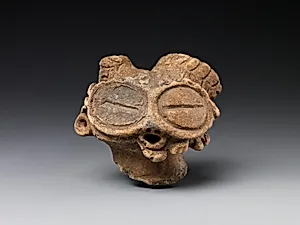
土偶|Head of a Figure (Dogū)
Unknown Artist
Medium
Earthenware with incised and cord-marked designs
Dimensions
H. 2 1/2 in. (6.4 cm); W. 2 3/4 in. (7 cm); D. 2 1/2 in. (6.4 cm)
Classification
Ceramics
Culture & Period
Japan · Final Jōmon period (ca. 1000–300 B.C.) or later
Department
Asian Art
Museum
Metropolitan Museum of Art, New York, NY
Credit
The Harry G. C. Packard Collection of Asian Art, Gift of Harry G. C. Packard, and Purchase, Fletcher, Rogers, Harris Brisbane Dick, and Louis V. Bell Funds, Joseph Pulitzer Bequest, and The Annenberg Fund Inc. Gift, 1975
Accession Number
1975.268.194
Rights
Public Domain
Tags
Art Historical Context
This petite earthenware head, known as a *Dogū*, hails from Japan's Final Jōmon periodca. 1000–300 B.C.) or later, a time when hunter-gatherer communities crafted some of the world's earliest complex pottery. Part of the enigmatic Dogū tradition—small clay figurines often featuring stylized human or hybrid forms—this piece invites us into prehistoric Japan, where such objects likely held ritual or symbolic importance, perhaps linked to fertility, protection, or spiritual beliefs. Crafted from earthenware, the head showcases Jōmon ingenuity through incised lines—delicately carved patterns—and cord-marked designs, created by pressing twisted cords into the wet clay for textured, rope-like effects. Standing just 2½ inches tall, its compact form (H. 2½ in.; W. 2¾ in.; D. 2½ in.) suggests it was handmade for intimate, possibly votive use, reflecting the era's advanced ceramic techniques without the wheel. Housed in the Metropolitan Museum of Art's Asian Art Department, this artifact from The Harry G. C. Packard Collection evokes the Jōmon people's deep connection to nature and the supernatural, blending human-like features with animalistic tags that hint at shamanistic inspirations. A window into Japan's ancient artistic soul!