
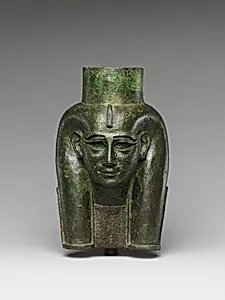
Head of a goddess, probably Mut, for attachment to a processional barque (?)
Unknown Artist
ca. 700 B.C.
Medium
Cupreous alloy, gold leaf, formerly inlaid
Dimensions
H. 17.5 cm (6 7/8 in); H. of face (forehead to chin) 5.2 cm (2 in); H. of modius 3.5 cm (1 3/8 in); depth 14 cm total (5 1/2 in) including 2.5 cm (1 in) of perpendicular attachment element extending beyond headdress
Classification
Head, goddess Mut, protome
Period
Third Intermediate Period
Department
Egyptian Art
Museum
Metropolitan Museum of Art, New York, NY
Credit
Purchase, Liana Weindling Gift, in memory of her mother, 2008
Accession Number
2008.353
Rights
Public Domain
Tags
Art Historical Context
This exquisite head, likely depicting the goddess Mut—consort of the god Amun and a powerful protector deity—dates to around 700 B.C. during Egypt's Third Intermediate Period, the Kushite 25th Dynasty. Crafted by an unknown artist, it hails from a time when Nubian rulers Kush governed Egypt, ushering in a revival of Egyptian religious practices and artistic grandeur after centuries of fragmentation. Fashioned from cupreous alloy (a copper-based metal evoking bronze), the sculpture was once adorned with shimmering gold leaf and inlays—possibly colorful stones or glass for the eyes and jewelry—that heightened its divine aura. Measuring just 17.5 cm high, with a delicate 5.2 cm face and a modius headdress symbolizing fertility, it features a rear attachment peg, suggesting it adorned a processional barque. These sacred boats were paraded during festivals, allowing gods to "journey" among worshippers and renew cosmic order. Its Kushite origins highlight cultural fusion: Nubian pharaohs like Taharqo championed Mut's cult at Thebes, blending Egyptian piety with African influences. Now at the Metropolitan Museum of Art, this fragile relic offers a glimpse into ancient rituals where art bridged the mortal and divine.