
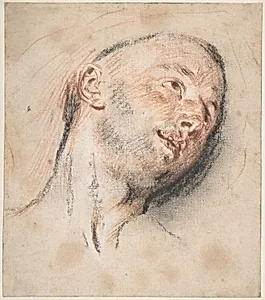
Head of a Man
Antoine Watteau, ca. 1718
About this artwork
Step into the intimate world of Antoine Watteau *Head of a Man* (ca. 1718), a masterful drawing that captures the French Rococo master's unparalleled sensitivity to human expression. Created with red and black chalk on a modest 5 7/8 x 5 3/16 inches sheet, this work exemplifies Watteau's (1684–1721) genius for portrait studies. As a pioneer of the Rococo style—known for its playful elegance and fêtes galantes—this piece likely served as a preparatory sketch, showcasing his fluid line work and subtle tonal modeling that brought his painted figures to life. Watteau's use of red chalk for warm flesh tones and black for dramatic shadows highlights his innovative "trois crayons" technique (though here without white), a method that influenced generations of draftsmen. The close-cropped view emphasizes the subject's thoughtful gaze and textured features, inviting viewers to ponder his identity—perhaps a model or fellow artist from Watteau's bohemian Paris circles. Housed in the Metropolitan Museum of Art's Drawings and Prints department (Rogers Fund, 1937), this gem reveals the artist's private process amid his short, brilliant career. It reminds us how Watteau elevated drawings from mere studies to poetic standalone works, bridging Baroque grandeur with Rococo intimacy.