
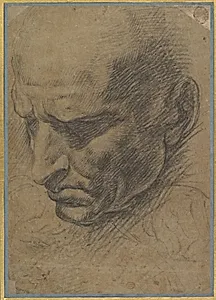
Head of a Man
16th century
Medium
Black chalk
Dimensions
14- 5/8 x 10- 1/4 in. (37.1 x 26.0 cm)
Classification
Drawings
Department
Drawings and Prints
Museum
Metropolitan Museum of Art, New York, NY
Credit
Rogers Fund, 1906
Accession Number
06.1042.21
Rights
Public Domain
Tags
Art Historical Context
This evocative *Head of a Man*, by an anonymous Italian artist in 16th-century Rome, the Renaissance fascination with human anatomy and expression. During this golden age of art in the Eternal City—home to masters like Michelangelo and Raphael—ings like this served as vital studies for painters and sculptors. Likely sketched from life or imagination, it exemplifies the period's emphasis on naturalistic portraiture, where artists honed their skills in rendering facial features, hair, and subtle emotional depth. Executed in black chalk, a favored medium of the era for its soft, tonal versatility, the drawing measures 14⅝ × 10¼ inches (37.1 × 26 cm). Black chalk allowed for delicate modeling through hatching and blending, creating volume and lifelike shadows without the hardness of metalpoint or the vibrancy of color. Such preparatory sheets were prized in artists' workshops, often collected by connoisseurs for their raw authenticity. Acquired by The Metropolitan Museum of Art through the Rogers Fund in 1906, this work from the Drawings and Prints department invites us to appreciate the unsung labor behind Renaissance masterpieces. Gaze closely at the textured lines and contemplative gaze—it's a timeless window into the artist's hand and the human spirit.