
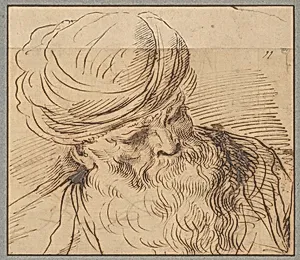
Head of a Man with a Turban
mid-17th century
Medium
Pen and brown ink.
Dimensions
6-1/4 x 7-1/8 in. (158 x 181 mm.)
Classification
Drawings
Department
Robert Lehman Collection
Museum
Metropolitan Museum of Art, New York, NY
Credit
Robert Lehman Collection, 1975
Accession Number
1975.1.366
Rights
Public Domain
Tags
Art Historical Context
This delicate drawing, *Head of a Man with Turban*, created by an imitator of the renowned Baroque master Guercino in the mid-17th century, the essence of Italian draftsmanship from Bologna's vibrant artistic scene. Guercino (Giovanni Francescoieri, 1591–1666) was celebrated for his dramatic tenebrism—bold contrasts of light and shadow—and fluid, expressive figures. Though not by the artist himself, this work emulates his energetic style, likely serving as a study for a larger painting or an independent collector's piece. Executed in pen and brown ink on a modest scale (6-1/4 x 7-1/8 inches), the medium highlights the artist's mastery of line. Precise contours and subtle hatching build form and texture, evoking the turban's folds and the man's intense gaze. Such drawings were prized in the 17th century for their immediacy, bridging preparatory sketches and finished art, and reflecting Baroque interests in human emotion and exotic "types"—here, the turban nods to Oriental influences popular in European portraiture. Now in the Robert Lehman Collection at The Metropolitan Museum of Art, this piece invites visitors to appreciate the intimacy of old master drawings, where every stroke reveals the hand of a skilled follower honoring Guercino's legacy.