
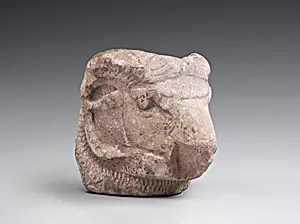
Head of a ram
Unknown Artist
ca. 5th–4th century BCE
Medium
Limestone (tura)
Dimensions
2.99 x 2.48 x 3.07 in. (7.59 x 6.3 x 7.8 cm)
Classification
Stone-Sculpture
Culture & Period
Achaemenid · Achaemenid
Department
Ancient Near Eastern Art
Museum
Metropolitan Museum of Art, New York, NY
Credit
Rogers Fund, 1961
Accession Number
61.120
Rights
Public Domain
Tags
Art Historical Context
This delicate limestone head of a ram, carved from fine-grained Tura stone around the 5th–4th century BCE, exemplifies the refined artistry of the Achaemenid Empire the vast Persian realm that stretched from the Indus Valley to the Mediterranean. Measuring just under 3 inches tall, this intimate sculpture likely served as a votive offering, architectural ornament, or amulet, reflecting the empire's mastery of stone carving. Acquired through the Rogers Fund in 1961, it now graces the Metropolitan Museum of Art's Department of Ancient Near Eastern Art. In Achaemenid culture, rams symbolized strength, fertility, and divine protection, often appearing in seals, reliefs, and jewelry alongside motifs like griffins and bulls. This piece captures the animal's alert expression and curling horns with naturalistic precision, blending Mesopotamian influences with Persian elegance. The choice of Tura limestone—prized for its smooth texture and translucency—allowed sculptors to achieve subtle modeling and lifelike details, techniques honed in royal workshops at Persepolis and Susa. Though its exact provenance remains unknown, the ram's head invites us to imagine the multicultural world of Achaemenid artisans, where Greek, Egyptian, and local styles converged under imperial patronage, producing enduring symbols of power and piety.