
Head of a Young Woman
1522
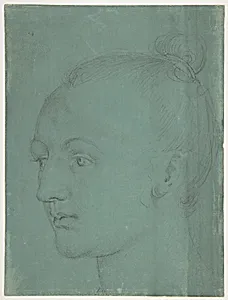
Medium
Black chalk highlighted with white chalk (abraded) on green prepared paper.
Dimensions
7 7/8 x 5 15/16 in. (20 x 15.1 cm)
Classification
Drawings
Department
Robert Lehman Collection
Museum
Metropolitan Museum of Art, New York, NY
Credit
Robert Lehman Collection, 1975
Accession Number
1975.1.859
Rights
Public Domain
Tags
Art Historical Context
Albrecht Dürer, the preeminent German artist of the Northern Renaissance, created *Head of a Young Woman* in 1522, just six years before his death. This intimate drawing captures the delicate features of its subject with Dürer's signature precision and lifelike realism, reflecting his lifelong fascination with human anatomy and expression. At a modest 7 7/8 x 5 15/16 inches, it exemplifies his skill in producing highly finished studies that stand alone as works of art, rather than mere preparations for larger pieces. Executed in black chalk heightened with white chalk on green prepared paper—a technique Dürer mastered for dramatic chiaroscuro effects—the drawing showcases subtle modeling of light and shadow to convey volume and texture. The abraded white highlights, softened by time, enhance its tactile quality, evoking the softness of skin and the fall of light on youthful contours. Green paper, popular among Northern artists, provided a mid-tone ground that allowed for efficient yet nuanced rendering. Housed in the Robert Lehman Collection at The Metropolitan Museum of Art, this drawing highlights Dürer's influence in blending meticulous observation with Renaissance ideals of beauty. It invites visitors to ponder the anonymous woman's gaze, a testament to the artist's ability to infuse everyday subjects with profound emotional depth.
About the Artist
Albrecht Dürer · 1471–1528
Albrecht Dürer (1471–1528) stands as the preeminent figure of the Northern Renaissance and arguably the most influential artist in the history of printmaking. Born in Nuremberg on May 21, 1471, and dying in the same city on April 6, 1528, Dürer revolutionized the status of the artist in Northern Europe, transforming printmaking from a commercial craft into an independent fine art and establishing ...