
Head of Ahmose I
Unknown Artist
ca. 1550–1525 B.C.
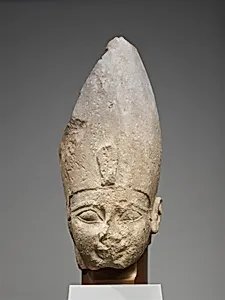
Medium
Limestone
Dimensions
H. 56 cm (22 1/16 in); d. 36.2 cm (14 1/4 in.)
Classification
Head, King Ahmose
Period
New Kingdom
Department
Egyptian Art
Museum
Metropolitan Museum of Art, New York, NY
Credit
Gift of Nanette R. Kelekian, in memory of Beatrice and Charles Dikran Kelekian, 2006
Accession Number
2006.270
Rights
Public Domain
Tags
Art Historical Context
Behold the striking *Head of Ahmose I*, a masterful limestone sculpture from ancient Egypt's New Kingdom, to around 1550–1525 B.C. This life-sized fragment, standing 56 cm tall, captures the visage of Ahmose I, the pharaoh who founded the th Dynasty and liberated Egypt from Hyksos rule, ushering in an era of imperial power and prosperity. Carved in the early years of this transformative period, it exemplifies the refined artistry of Dynasty 18, where royal portraits emphasized idealized strength and divine authority. Crafted from durable limestone—a favored medium for its workability and ability to hold fine details—the head showcases the Egyptians' mastery of subtractive sculpture. Subtle modeling of the facial planes, broad shoulders, and serene yet commanding expression reflect conventions of pharaonic iconography, blending realism with eternal symbolism. Though the artist remains unknown, the piece's precision speaks to the workshops of Thebes, heart of New Kingdom culture. Today, this treasure graces the Egyptian Art galleries of the Metropolitan Museum of Art, a gift honoring the Kelekian family. It invites us to ponder Ahmose I's legacy: a warrior-king whose victories laid the foundation for Egypt's golden age.