
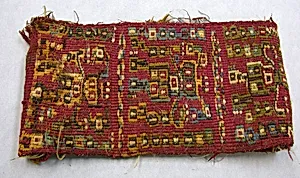
Headband
Unknown Artist
7th–10th century
Medium
Cotton, camelid hair
Dimensions
H. 4 1/2 × Diam. 5 3/4 in. (11.4 × 14.6 cm)
Classification
Textiles-Woven
Culture
Wari
Department
Arts of Africa, Oceania, and the Americas
Museum
Metropolitan Museum of Art, New York, NY
Credit
Bequest of Arthur M. Bullowa, 1993
Accession Number
1994.35.111
Rights
Public Domain
Art Historical Context
This exquisite headband, crafted by an unknown Wari artist between the 7th and 10th centuries, exemplifies the mastery of Andean textile weaving during the height of the Wari empire in ancient Peru. Made from finely spun cotton and luxurious camelid hair—likely from alpacas or vicuñas—the circular band measures just 4½ inches high and 5¾ inches in diameter, designed to encircle the forehead as part of elite regalia. Wari textiles were not mere adornments but powerful symbols of status, cosmology, and cultural identity, often worn by rulers or priests in rituals. The Wari, a pre-Inca civilization that flourished in Peru's Andean highlands, revolutionized weaving techniques, producing intricate patterns on backstrap looms that conveyed mythological narratives and social hierarchies. Camelid fibers provided exceptional durability, vibrant dye absorption, and a soft luster, making them prized for high-status items like this headband. Such artifacts highlight the Wari's expansive influence across South America, where textiles served as currency, diplomatic gifts, and tomb offerings. Today, this rare survivor—bequeathed to the Metropolitan Museum of Art in 1993—invites us to marvel at the ingenuity of Wari artisans, whose legacy in fiber arts paved the way for later Inca masterpieces. A testament to everyday luxury in an ancient world.