
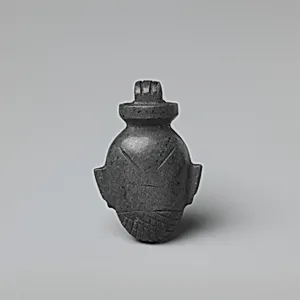
Heart amulet
Unknown Artist
664–30 B.C.
Medium
Green stone
Dimensions
H. 3 cm (1 3/16 in), w. 2.1cm (13/16 in)
Classification
Amulet, heart
Period
Late Period–Ptolemaic Period
Department
Egyptian Art
Museum
Metropolitan Museum of Art, New York, NY
Credit
Gift of Helen Miller Gould, 1910
Accession Number
10.130.1797
Rights
Public Domain
Art Historical Context
This small heart amulet, carved from green stone between 664 and 30 B.C., dates to Egypt’s Late Period the Ptolemaic era. At just 3 centimeters tall, the compact form was designed to rest against the body, most often within burial wrappings. Its simple yet precise shaping reflects the skilled lapidary traditions of the time, when artisans transformed hard stone into meaningful protective objects for everyday and funerary use. In ancient Egyptian belief, the heart held the seat of thought, memory, and moral character. Such amulets were placed with the deceased to safeguard this vital organ during the afterlife judgment, ensuring it would speak truthfully when weighed against the feather of Ma’at. The green color of the stone further evoked ideas of regeneration and eternal life, qualities Egyptians associated with renewal and the gods. Acquired by the Metropolitan Museum of Art in 1910 as a gift from Helen Miller Gould, the amulet offers modern visitors an intimate connection to the spiritual hopes of ancient Egyptians. Its modest scale and enduring material remind us how personal devotion was expressed through finely crafted symbols meant to last forever.