
Heart scarab
Unknown Artist
ca. 1550–1186 B.C.
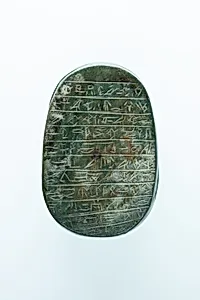
Medium
Green stone
Dimensions
L. 5.9 cm (2 5/16 in.); W. 3.8 cm (1 1/2 in.); H. 2.5 cm (1 in.)
Classification
Heart scarab
Period
New Kingdom
Department
Egyptian Art
Museum
Metropolitan Museum of Art, New York, NY
Credit
Gift of Mrs. Frederick F. Thompson, 1915
Accession Number
15.6.40
Rights
Public Domain
Tags
Art Historical Context
This exquisite heart scarab, carved from vibrant green stone during Egypt’s New Kingdom (Dynasties 18–19, ca. 1550–1186 B.C.), served as a powerful funerary amulet. Measuring just under six centimeters long, it was placed on or within the mummy’s chest to safeguard the heart—the seat of thought, memory, and moral judgment—during the perilous journey to the afterlife. Green stone was deliberately chosen for its symbolic association with rebirth and vegetation, evoking the regenerative powers of Osiris. Inscribed with hieroglyphs, the scarab likely carried protective spells drawn from the Book of the Dead, ensuring the deceased’s heart would not betray them when weighed against the feather of truth. Scarabs, modeled after the dung beetle that rolls its eggs in a ball of dung, embodied the sun’s daily renewal and the promise of eternal life. Though the artist remains unknown, the precise carving reflects the refined lapidary skills of New Kingdom artisans. Acquired by the Metropolitan Museum of Art in 1915 as a gift, this small yet potent object offers visitors a tangible connection to ancient Egyptian beliefs about death, morality, and resurrection.