
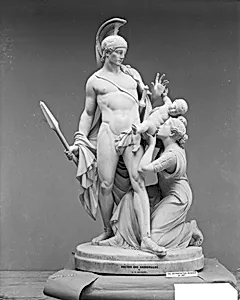
Hector and Andromache
Medium
Marble
Dimensions
Overall (rough, on-site dimensions): 78 × 41 × 26 in. (198.1 × 104.1 × 66 cm)
Classification
Sculpture
Culture
Italian, Rome
Department
European Sculpture and Decorative Arts
Museum
Metropolitan Museum of Art, New York, NY
Credit
Gift of Mrs. Lawrence Kip, 1899
Accession Number
99.9a, b
Rights
Public Domain
Tags
Art Historical Context
In the grand tradition of neoclassical sculpture, Giovanni Maria Benzoni *Hector and Androm* (1871) captures a poignant moment from Homer's *Iliad*. The Italian sculptor, based in Rome, depicts the Trojan prince Hector bidding farewell to his wife Andache and their infant son Astyanax heading to battle. Hector, shown as a muscular male nude grasping a spear, stands protectively as Andromache clings to him in evident sorrow, evoking the timeless themes of love, duty, and impending tragedy that resonated deeply in 19th-century Europe. Carved from a massive block of marble—measuring nearly 78 inches tall—this work showcases Benzoni's mastery of the medium. Marble's luminous polish allows for intricate detailing in the figures' expressive faces, flowing drapery on Andromache, and the tender interaction with the child, blending classical idealism with Romantic emotional intensity. Such sculptures were prized in Gilded Age collections for their evocation of ancient heroism amid modern sentimentality. A gift to the Metropolitan Museum of Art in 1899 from Mrs. Lawrence Kip, this piece highlights the era's fascination with Greco-Roman myths, serving as both a technical marvel and a meditation on human vulnerability. Visitors can't help but feel the weight of Hector's fateful departure.
About the Artist
Giovanni Maria Benzoni · 1809–1873
**Giovanni Maria Benzoni (1809–1873)** was an Italian neoclassical sculptor renowned for his elegant marble figures that captured the refined tastes of 19th-century collectors on the Grand Tour. Born on August 28, 1809, in the small mountain village of Songavazzo near Bergamo to a family of modest means, Benzoni began his working life as a shepherd and then as an apprentice carpenter in his uncle’...