
Heian Period Courtier on a Moonlit Beach
Kobayashi Kiyochika, 19th century
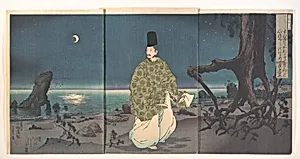
About this artwork
In the serene glow of a full moon, Kobayashi Kiyochika's *Heian Period Courtier a Moonlit Beach* (19th century) captures a lone nobleman from Japan's classical Heian era (794–1185) strolling along a misty shore. This tript of woodblock prints—composed of three panels in ink and color on paperunfurls a panoramic nocturne, with dimensions allowing for an immersive vertical and horizontal expanse (each panel roughly 14 x 9½ inches). Kiyochika, a pivotal Meiji-period (1868–1912) artist, masterfully renders the scene's ethereal light, where moonlight dances on waves and silhouettes the courtier's flowing robes, evoking timeless poise amid nature's quiet drama. Kiyochika bridged ukiyo-e traditions with Western realism during Japan's rapid modernization, pioneering innovative techniques like subtle gradations of color and shadow to depict night scenes with unprecedented luminosity. Unlike brighter kabuki prints, his works often romanticize historical figures against contemporary backdrops, blending nostalgia for Heian court's refined elegance—think poetry and impermanence—with Meiji-era introspection. This piece, from the Metropolitan Museum of Art's Asian Art collection (Bequest of William S. Lieberman, 2005), highlights woodblock printing's cultural pinnacle: affordable artistry that democratized beauty for everyday viewers. Visitors will appreciate how the triptych format expands the solitary beach walk into a meditative journey, inviting reflection on solitude, history, and the moon's enduring allure in Japanese aesthetics.