
Hell
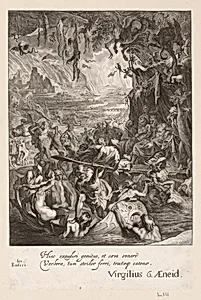
Medium
Engraving
Dimensions
Sheet: 11 in. × 7 3/16 in. (28 × 18.3 cm)
Classification
Prints
Department
Drawings and Prints
Museum
Metropolitan Museum of Art, New York, NY
Credit
The Elisha Whittelsey Collection, The Elisha Whittelsey Fund, 1951
Accession Number
51.501.1639(43)
Rights
Public Domain
Art Historical Context
Abraham van Diepenbeeck's *Hell* (1655) is a striking engraving that captures the dramatic terrors of the infernal realm, a popular motif in 17th-century European art. Created during the Baroque era in the Spanish Netherlands, this print exemplifies the period's intense focus on religious themes, emotion, and the macabre, often serving as moral warnings amid the Counter-Reformation's fervor. Van Diepenbeeck, a Flemish artist known for his work in painting and printmaking, likely drew on his training in Antwerp—Rubens' orbit—to infuse the scene with vivid, theatrical energy. As an engraving, the work's medium is key to its impact: this intaglio technique allowed for fine lines and rich tonal contrasts on a modest sheet (11 × 7 3/16 in.), enabling detailed depictions of torment and chaos that could be widely reproduced and shared. Prints like this bridged elite art with broader audiences, amplifying their didactic power. Housed in the Metropolitan Museum of Art's Drawings and Prints department through The Elisha Whittelsey Collection (1951), *Hell* invites visitors to ponder the artist's masterful balance of horror and artistry, a window into Baroque devotion and human fears.