
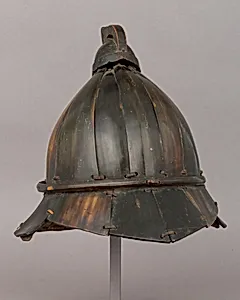
Helmet
Unknown Artist
18th–19th century
Medium
Horn, leather, hair (all water buffalo)
Dimensions
H. 11 1/4 in. (28.6 cm); W. 10 3/8 in. (26.4 cm); D. 13 1/8 in. (33.3 cm); Wt. 2 lb. 8.6 oz. (1151 g)
Classification
Helmets
Culture
Philippine, Moro
Department
Arms and Armor
Museum
Metropolitan Museum of Art, New York, NY
Credit
Bequest of George C. Stone, 1935
Accession Number
36.25.98
Rights
Public Domain
Art Historical Context
This remarkable helmet, crafted by an unknown Moro artist in the Philippines during the 18th19th century, exemplifies the ingenuity of indigenous craftsmanship in Southeast Asia. Made entirely from water buffalo horn, leather, and hair, it measures about 11 inches high and weighs just over 2 pounds, it both lightweight for battle and impressively durable. The use of these natural materials highlights the Moro people's resourcefulness, drawing from the abundant water buffalo central to their agrarian and warrior lifestyles. Belonging to the Moro culture—an indigenous Muslim group in the southern Philippines renowned for their resistance against Spanish and later American colonizers—this helmet likely served as protective headgear in fierce conflicts. Moro armorers were master artisans, often weaving organic elements like horn and hair into functional yet symbolically potent designs, blending utility with cultural identity. Now housed in the Metropolitan Museum of Art's Arms and Armor Department through the bequest of George C. Stone in 1935, this piece offers a tangible link to Moro martial traditions. It invites us to appreciate how everyday resources transformed into symbols of defiance and heritage.