
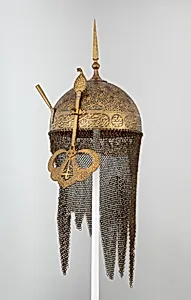
Helmet, Shield, and Arm Guard
Unknown Artist
17th–19th century
Medium
Steel, gold, copper alloy
Dimensions
Helmet (a); H. including mail 24 in. (61 cm); H. including nasal 17 in. (43.2 cm); H. excluding mail and nasal 10 in. (25.4 cm); W. 9 1/4 in. (23.5 cm); D. 10 5/8 in. (27 cm); Wt. 3 lb. 1.2 oz. (1394.8 g)
Classification
Armor Parts
Culture
Deccan, Indian
Department
Arms and Armor
Museum
Metropolitan Museum of Art, New York, NY
Credit
Bequest of George C. Stone, 1935
Accession Number
36.25.63a–c
Rights
Public Domain
Art Historical Context
This striking ensemble of a helmet, shield, and guard hails from the Deccan of India, crafted between the 17th 19th centuries during a vibrant era of sultanates like Bijapur and Golconda. These armor parts reflect the martial prowess of Deccani warriors, who blended Persian, Turkish, and indigenous Indian influences in their defenses. Worn by cavalry or nobility, the pieces would have protected fighters in intense battles while signaling status through their luxurious materials. Forged primarily from steel for strength, the armor is enriched with gold and copper alloy, likely inlaid or overlaid to create shimmering patterns that catch the light—a technique prized in Islamic-influenced Deccani metalwork. The helmet alone boasts impressive dimensions: 24 inches high with its mail hood and nasal guard, weighing just over 3 pounds, balancing protection with mobility. Such opulent detailing elevated functional gear into art, embodying the Deccan's cultural fusion of warfare and aesthetics. Bequeathed to the Metropolitan Museum of Art in 1935 by George C. Stone, this set offers a window into India's storied arms tradition, where beauty met battlefield necessity. Visitors, imagine the clash of steel and gleam of gold under the South Asian sun!