
Hendrick Goltzius
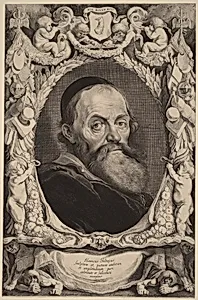
Medium
etching and engraving on laid paper
Dimensions
image (cut within platemark): 39.9 x 26 cm (15 11/16 x 10 1/4 in.) sheet: 40 x 26.1 cm (15 3/4 x 10 1/4 in.)
Classification
Department
CG-E
Museum
National Gallery of Art, Washington, D.C.
Credit
Ailsa Mellon Bruce Fund
Accession Number
2000.92.1
Rights
Public Domain
Art Historical Context
This striking portrait print, titled *Hendrick Goltzi* (1649), honors the renowned Dutch engraver and draftsman Hendrick Goltzius (1558–1617), a pivotal figure in Northern Mannerism. Created by Jonas Suyderhoff after design by Pieter Claeszman—a painter and engraver influenced by Peter Paul Rubens— it captures Goltzius likeness with remarkable fidelity. Measuring nearly 40 x 26 cm, the image was etched and engraved on laid paper, a period-standard medium prized for its texture and durability, which allowed for fine details in reproductions. Etching and engraving techniques shine here: etching uses acid to bite lines into a metal plate for fluid, expressive strokes, while engraving carves them manually for precise control—perfect for conveying Goltzius's intense gaze and textured clothing. Produced during the Dutch Golden Age, such prints democratized access to celebrated artists' images, serving as tributes in an era when printmaking rivaled painting in prestige. Housed in the National Gallery of Art's print collection (acquired via the Ailsa Mellon Bruce Fund), this work exemplifies 17th-century reproductive print culture, preserving Goltzius's legacy as a master whose innovative "swelling line" technique influenced generations of European artists. A testament to artistic homage across time.