
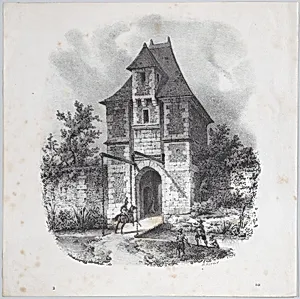
Henri IV Entering at Aumale
Medium
Lithograph; only state
Dimensions
Sheet: 8 13/16 × 8 3/4 in. (22.4 × 22.3 cm)
Classification
Prints
Department
Drawings and Prints
Museum
Metropolitan Museum of Art, New York, NY
Credit
The Elisha Whittelsey Collection, The Elisha Whittelsey Fund, 1959
Accession Number
59.500.422
Rights
Public Domain
Art Historical Context
Step into the dramatic world of early 19-century France with *Henri IV Entering at Aale*, a captivating lithograph created in 1822 by Vernet in collaboration with Louis-Julesédéric Villeneuve. This print, measuring just 8 13/16 × 8 3/4 inches, captures King Henri IV of France triumphantly entering the town of Aumale pivotal moment from his reign. Housed in the Metropolitan Museum of Art Drawings and Prints department as part of The Elisha Whitt Collection, it's a rare "only state," meaning no variant editions exist, preserving its unique authenticity. Henri IV (1553–1610), the first Bourbon king, is celebrated for ending the French Wars of Religion with the Edict of Nantes in 1598. His 1594 capture of Aumale from the Catholic League symbolized his push for unity and religious tolerance amid brutal conflicts. Vernet, a master of Romanticism known for his dynamic history paintings and military scenes, brings this event to life with lithographic precision, evoking the era's fascination with heroic nationalism during the Restoration period. Lithography, a revolutionary medium invented just decades earlier, allowed artists like Vernet to produce affordable, detailed reproductions blending drawing and printing. This technique's greasy crayon marks likely infuse the scene with movement and texture, making grand history accessible to a wider audience and underscoring the cultural revival of France's royal past. A gem for print enthusiasts!
About the Artist
Louis-Jules-Fréderic Villeneuve|Horace Vernet (French|French) · 1796 |1789 –1842 |1863
French, 1796–1842|French, Paris 1789–1863 Paris