
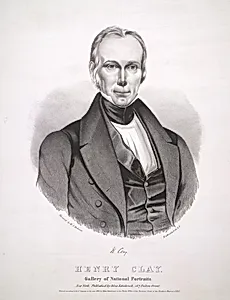
Henry Clay
Medium
Classification
Department
Smithsonian Collection
Museum
Smithsonian American Art Museum
Credit
National Portrait Gallery, Smithsonian Institution
Accession Number
NPG.99.134
Rights
Public Domain
Tags
Art Historical Context
Step into the world of 19th-century American politics this striking 1844 lithographic portrait of Henry Clay, produced by the Endicott Lithography Company, prolific New York firm active from 1828 1886. Captured in an intimate interior setting, the print showcases Clay as a commanding figure—dressed in formal attire, gazing directly at the viewer. Lithography, a revolutionary printing technique invented decades earlier, allowed for detailed, affordable reproductions, making portraits like this accessible to everyday Americans far beyond elite circles. Henry Clay, the Kentucky native depicted here, was a towering statesman: a skilled lawyer, influential Speaker of the House, and Secretary of State under John Quincy Adams. In 1844, this image coincided with his presidential bid as the Whig Party nominee, embodying the era's heated political fervor. Clay's "American System"—promoting infrastructure, tariffs, and banking—shaped national debates, though he lost to James K. Polk. Housed in the Smithsonian American Art Museum's National Portrait Gallery collection, this print highlights how visual media fueled democracy, turning politicians into household names and immortalizing Clay's legacy as "The Great Compromiser" amid growing sectional tensions. A snapshot of ambition and artistry in antebellum America.