
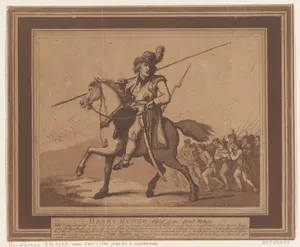
Henry Munro, Chief of the Irish Rebels
July 1, 1798
Medium
Etching and aquatint
Dimensions
Sheet: 10 11/16 in. × 13 in. (27.1 × 33 cm)
Classification
Prints
Department
Drawings and Prints
Museum
Metropolitan Museum of Art, New York, NY
Credit
The Elisha Whittelsey Collection, The Elisha Whittelsey Fund, 1959
Accession Number
59.533.544
Rights
Public Domain
Tags
Art Historical Context
Step into the turbulent world of late 18th-century Britain with Thomas Rowlandson's *Henry Munro, Chief of the Rebels* (July 1, 1798), a vivid etching and aquatint the Metropolitan Museum of Art's Prints collection. Rowlandson, a master of satirical caricature during the Regency era, captures the chaos of rebellion through dynamic scenes of men and horses, rendered on a sheet measuring 10 11/16 × 13 inches. The etching technique provides crisp, expressive lines for figures and action, while aquatint adds rich tonal depth, evoking the drama of battle and evoking a sense of immediacy in printmaking. This work responds to the Irish Rebellion of 1798, a pivotal uprising against British rule where United Irishmen, including Presbyterian leader Henry Munro, fought for independence. Munro's defeat at the Battle of Ballynahinch just days before the print's date underscores its timeliness—Rowlandson likely produced it as topical commentary, blending caricature's humor with political bite to mock or sensationalize the rebels. As part of The Elisha Whittelsey Collection, this print highlights Rowlandson's role in shaping public opinion through affordable, widely circulated etchings. It invites us to reflect on how art amplified the era's conflicts, offering a window into the fervor and fragility of revolutionary fervor.
About the Artist
Thomas Rowlandson · 1756–1827
Thomas Rowlandson (1757–1827) was an English artist and caricaturist whose satirical watercolors and prints captured the social life of Georgian Britain with unparalleled wit and technical mastery. Alongside James Gillray, he is recognized as one of the greatest British graphic artists, and his distinctive flowing line and keen observations have made his work integral to understanding late 18th an...