
Henry Rushbury
1914
Medium
drypoint
Dimensions
sheet: 31.3 × 35.2 cm (12 5/16 × 13 7/8 in.)
Classification
Department
CG-E
Museum
National Gallery of Art, Washington, D.C.
Credit
Rosenwald Collection
Accession Number
1943.3.3429
Rights
Public Domain
Art Historical Context
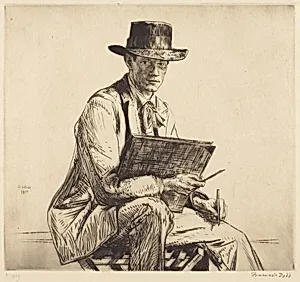
Francis Dodd’s 1914 drypoint presents a sensitive portrait of fellow artist Henry Rushbury. Created on the eve of the First World War, the print reflects the close-knit world of British etchers and printmakers who were then enjoying a lively revival of original printmaking. Dodd, recognized for both his portraits and urban scenes, used the directness of drypoint to convey Rushbury’s thoughtful gaze and the textures of his clothing with quiet economy. Drypoint is an intaglio process in which the artist scratches a copper or zinc plate with a sharp needle, raising a delicate burr of metal that holds ink and yields the characteristic soft, velvety line. Because the burr wears down quickly during printing, early impressions such as this one retain exceptional richness and tonal depth. The modest sheet size—roughly 31 by 35 centimeters—encourages intimate viewing, allowing the fine details to emerge only when the print is held close. Now part of the National Gallery of Art’s Rosenwald Collection, the work preserves a moment of artistic exchange between two figures who helped shape early-twentieth-century British graphic art.