
Henry VIII
1630
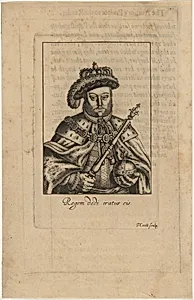
Medium
engraving
Dimensions
plate: 16.2 × 11.5 cm (6 3/8 × 4 1/2 in.)
Classification
Department
CG-E
Museum
National Gallery of Art, Washington, D.C.
Credit
Rosenwald Collection
Accession Number
1951.11.340
Rights
Public Domain
Art Historical Context
Thomas Cecil’s 1630 engraving offers a compact yet commanding portrait of Henry VIII, the Tudor king whose reign reshaped English history. At just 16.2 by 11.5 centimeters, the print was well suited for inclusion in books or private collections, allowing viewers to encounter the monarch’s image long after his death in 1547. Cecil, working in the tradition of English printmakers, used the engraving technique to translate an earlier painted likeness into a reproducible form. Engraving’s fine lines and precise cross-hatching were especially effective for rendering rich textures such as fur, velvet, and jewelry, helping to convey royal authority even on a small scale. By the early seventeenth century, such prints played an important role in circulating royal imagery across social classes, reinforcing the monarch’s presence in an age before photography. This impression belongs to the National Gallery of Art’s Rosenwald Collection, one of the world’s foremost holdings of prints. It invites modern visitors to consider how printmaking extended the reach of historical portraiture and preserved the memory of powerful figures for generations.