
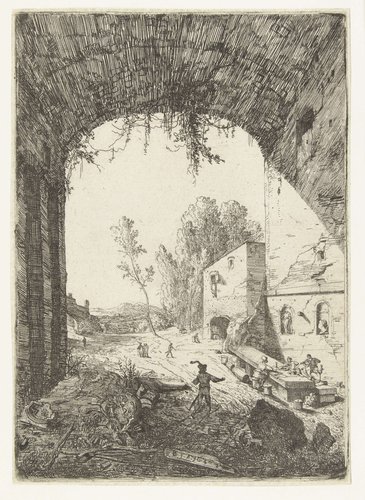
Herberg bij de Grotta della Ninfa Egeria
Medium
etching
Dimensions
127; 180
Rights
Public Domain
About this artwork
ets
Art Historical Context
Bartholomeus Breen's *Herberg bij de Grotta della Ninfa Eger* (Inn near the Grotto of Nymph Egeria), created in 1640, captures the timeless allure of ancient Rome through the Dutch artist's masterful etching. Breenbergh, a key figure in the Dutch Italianate landscape tradition during the Golden Age, spent years in Rome (c. 1624–1629), sketching ruins and pastoral scenes that inspired his later works. This intimate print (180 × 127 mm) depicts an inn nestled beside the historic Grotta della Ninfa Egeria—a natural cave in Rome's Parco degli Acquedotti, linked to the mythical nymph Egeria, advisor to King Numa Pompilius. The subject reflects the 17th-century fascination with classical antiquity, blending rugged Roman landscapes with everyday life—travelers, architecture, and foliage—to evoke nostalgia for Italy among Northern European audiences. Breenbergh's style emphasizes atmospheric depth and delicate details, characteristic of his small-scale landscapes that rival paintings in precision. As an etching, this work showcases the medium's revolutionary potential: acid biting into a metal plate allowed intricate lines and tonal gradations unattainable in earlier prints. Produced after Breenbergh's return to Amsterdam, it exemplifies how Dutch artists democratized "Grand Tour" experiences, making Rome's wonders accessible through affordable, reproducible art. A gem for lovers of topography and mythology!
About the Artist
Bartholomeus Breenbergh · 1598–1657
Probably was apprenticed in Amsterdam. He was one of the early Dutch italianates, that is, northern artists who travelled to Italy in the 1620s and were inspired by southern landscapes. On his return, he settled in Amsterdam and his landscapes were developed as more severe and monumental, often with historical subjects; strongly influenced by the Pre-Rembrandtists. Comment on works: Landscapes; Ru...