
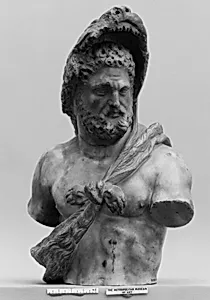
Hercules
Unknown Artist
1500–1550
Medium
White marble
Dimensions
Height: 11 1/4 in. (28.6 cm)
Classification
Sculpture
Culture
Italian
Department
European Sculpture and Decorative Arts
Museum
Metropolitan Museum of Art, New York, NY
Credit
Gift of J. Pierpont Morgan, 1917
Accession Number
17.190.814
Rights
Public Domain
Tags
Art Historical Context
This exquisite white marble sculpture of *Hercules*, crafted by an unknown Italian artist between 1500 1550, captures Renaissance fascination with classical mythology. Standing just 11¼ inches tall, this diminutive yet powerful statuette likely depicts the legendary hero in a moment of poised strength, embodying the humanist revival of ancient Greek and Roman ideals during Italy's High Renaissance. White marble, prized for its luminous quality and durability, was the medium of choice for sculptors emulating the grandeur of antiquity, allowing light to play across muscular forms with lifelike precision. Artistically, the work reflects the period's technical mastery in carving fine details—evident in the subtle modeling of anatomy and drapery—that brought marble to life. Hercules, the ultimate symbol of heroism and labor through his Twelve Labors, held cultural resonance in Renaissance Europe as a metaphor for human potential and virtue, often featured in princely collections or scholarly studioli. Generously gifted to the Metropolitan Museum of Art by J. Pierpont Morgan in 1917, this piece invites visitors to ponder the anonymous artisan's skill and the enduring allure of myth in art. A testament to Italy's sculptural legacy, it bridges ancient lore with Renaissance ingenuity.