
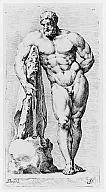
Hercules after the antique
17th century
Dimensions
sheet: 8 3/4 x 4 1/2 in. (22.2 x 11.4 cm)
Classification
Prints
Department
Drawings and Prints
Museum
Metropolitan Museum of Art, New York, NY
Credit
Gift of Harry G. Friedman, 1961
Accession Number
61.663.67
Rights
Public Domain
Tags
Art Historical Context
Jan de Bisschop's *Hercules after antique*, a 17th-century print measuring 8 3/4 x 4 1/2 inches, captures the timeless power of the mythological hero Hercules in a meticulous reproduction of a classical sculpture. Created during the Dutch Golden Age, this work exemplifies Bisschop's mastery as a draughtsman and engraver renowned for his faithful renderings of ancient Roman and statues. By translating the three-dimensional marble form into intricate lines on paper, he bridged antiquity and the Baroque era, making elite classical art accessible to a broader audience. This print reflects the era's fervent revival of Greco-Roman ideals, fueled by archaeological discoveries and humanism. Hercules, the ultimate symbol of strength and heroism through his Twelve Labors, embodied virtues celebrated in 17th-century Europe amid explorations of anatomy and heroism in art. Bisschop's precise etching technique—likely using burin or drypoint—preserves the sculpture's muscular torsion and contrapposto pose, highlighting the cultural reverence for antiquity that influenced artists like Rubens and Bernini. Housed in the Metropolitan Museum of Art's Drawings and Prints department since a 1961 gift from Harry G. Friedman, this modest yet profound sheet invites visitors to ponder how prints democratized the ancient world, sparking endless inspiration in Western art.
About the Artist
Jan de Bisschop · 1628–1671
Comment on works: drawings of Cityscapes & Landscapes