About this artwork
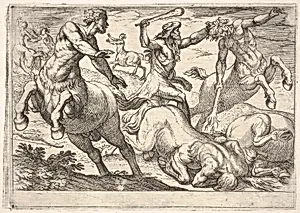
In the dynamic etching *Hercules and theaurs* (1608), Italian artist Antonio Tempesta captures pivotal moment from Greek mythology. Part of his renowned series *The Labors Hercules*, the print depicts the hero in fierce combat: with his left hand gripping a centaur's head and right raised to strike with a massive club, Hercules dominates the foreground. Fallen and fleeing centaurs scatter in chaos behind him, evoking the wild battle where Hercules aided the Lapiths against these half-man, half-horse beasts at a wedding feast gone awry.
Tempesta, a Florentine master of the late Mannerist and early Baroque periods, excelled in printmaking, producing over 2,000 etchings that popularized classical tales across Europe. Etching—a technique where acid bites intricate lines into a metal plate—allowed for the fine, expressive detailing of muscles, weapons, and motion seen here, making complex narratives affordable and widely collectible. Created amid Renaissance Italy's revival of antiquity, this small-scale work (plate: 3 15/16 x 5 9/16 in.) reflects the era's fascination with heroic strength and moral triumphs.
Today, housed in the Metropolitan Museum of Art's Drawings and Prints department through the 2011 bequest of Phyllis Massar, it invites us to marvel at Hercules' enduring symbol of human valor over savagery.